PKK Commander Declares Öcalan's Freedom a Prerequisite for Peace with Türkiye
Murat Karayılan, a senior PKK leader, dismissed disarmament without legal guarantees for Kurdish identity and the release of Abdullah Öcalan, underscoring the formidable hurdles facing potential normalization in Türkiye.
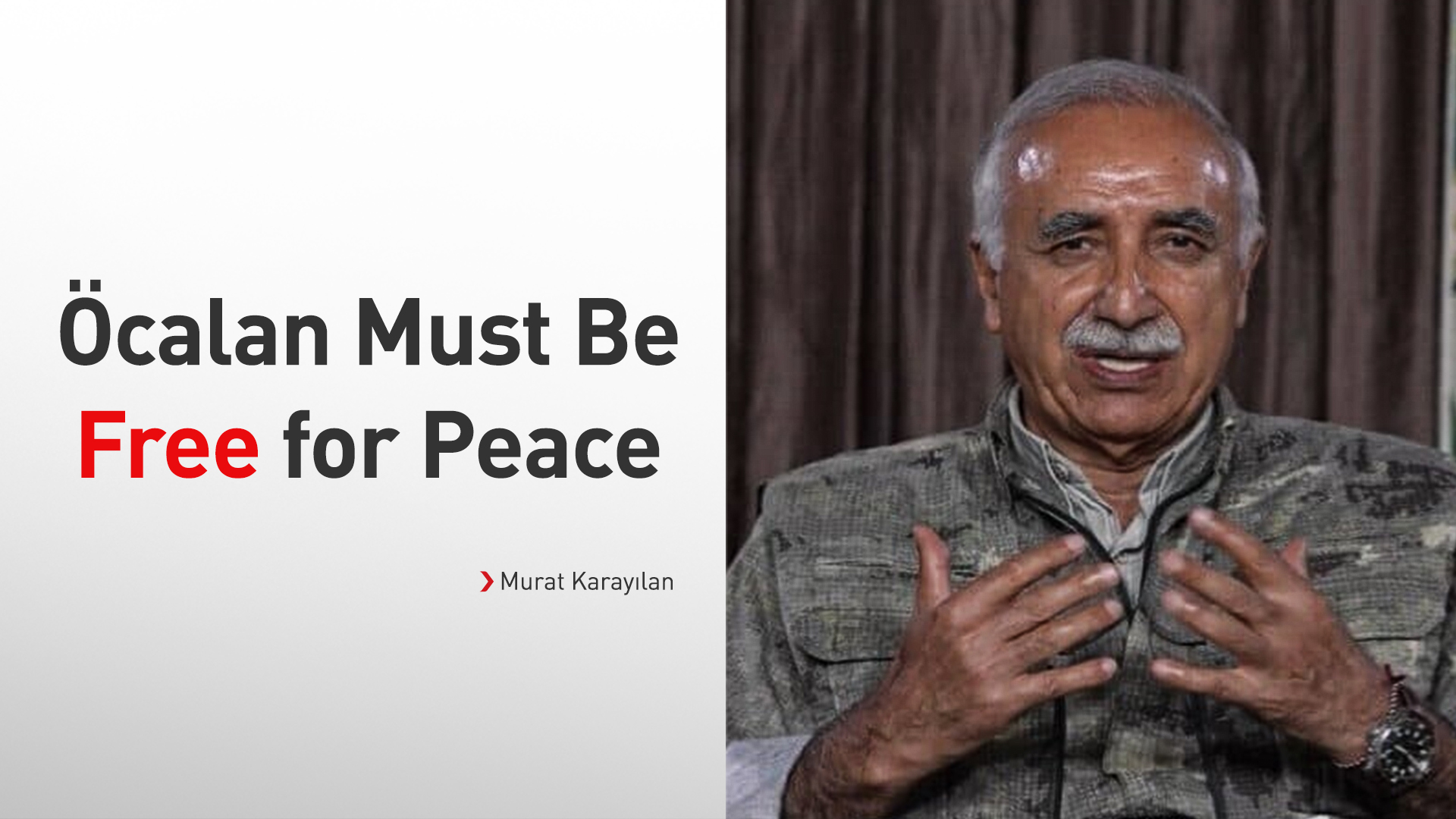
ERBIL (Kurdistan24) - A senior commander of the Kurdistan Workers' Party (PKK) has publicly outlined stringent conditions for any prospective peace settlement with the Turkish state, declaring that the release of imprisoned leader Abdullah Öcalan is an absolute prerequisite for resolving the decades-old conflict.
The remarks by Murat Karayılan, broadcast via a video message on a pro-PKK platform and reported by the Firat News Agency (ANF), arrive amid cautious speculation in Türkiye regarding a possible normalization or renewed peace process.
His comments underscore the immense political and legal hurdles facing any diplomatic breakthrough between Ankara and the Kurdish militant group, which is designated as a terrorist organization by Türkiye, the United States, and the European Union.
According to the ANF report, Karayılan dismissed the notion that the PKK would unilaterally disarm without comprehensive political concessions.
"For peace to be achieved between the Kurdish people and the Turkish state, Abdullah Öcalan must first be free," Karayılan stated, emphasizing that the imprisoned leader's status must be fundamentally clarified before negotiations can progress.
The Role of Abdullah Öcalan
The focus on Öcalan highlights the power he wields within the PKK's political decision-making. Captured in 1999 and held in solitary confinement on İmralı Island, Öcalan remains the foundational ideologue and figurehead of the PKK.
Reflecting this deep ideological loyalty, the PKK quite recently announced that it has changed its name to the "Apoist Movement", a direct reference to Öcalan's popular nickname, Apo, further cementing his status as the absolute center of the organization's identity.
Read More: PKK Announces Name Change to 'Apoist Movement'
During the last major peace process between 2013 and 2015, the Turkish state engaged in direct dialogue with Öcalan in an attempt to end the insurgency, which has claimed tens of thousands of lives since 1984. However, following the collapse of that ceasefire, the conflict resumed with devastating intensity in southeastern Türkiye and expanded into neighboring Syria and Iraq.
Karayılan argued that any new settlement requires Öcalan to act as the "chief negotiator" and primary interlocutor.
According to the ANF report, Karayılan insisted that Öcalan must be free to actively manage the disarmament process, stating, "For arms to be laid down, Abdullah Öcalan himself must develop this process. In other words, he must be free."
The PKK commander's demands extend beyond the fate of a single leader.
He asserted that a durable resolution requires a fundamental shift in the Turkish state's mentality, demanding that the existence of the Kurdish people be legally recognized in writing within the laws of the Republic.
"If we truly want to develop a resolution and achieve peace, the Kurds must be legally recognized," Karayılan said, according to ANF. "What could be more legitimate than that?"
Disarmament and Legal Guarantees
The prospect of disarmament remains a central sticking point in any potential Turkish-Kurdish dialogue.
Recently, elements of the Turkish political establishment, including nationalist leader Devlet Bahçeli, have publicly floated the idea of utilizing Öcalan to orchestrate the demobilization of PKK fighters.
Karayılan, however, firmly rejected a narrow focus on weapons.
He warned that if the Turkish government proposes legislation based "solely on disarmament," the PKK will not accept it.
According to ANF, he stated that guerrillas took up arms for "sacred purposes, for the existence and rights of the Kurdish people," adding, "Unless steps are taken on these issues, unless legal measures are enacted, the guerrillas will not lay down their arms."
He indicated that if Türkiye fulfills the dual conditions of freeing Öcalan and legally recognizing Kurds, the PKK would then consider a "democratic integration law" that could facilitate demobilization.
PKK at A Crossroad
Karayılan characterized the current geopolitical environment as an "extraordinary process" where the fate of the Kurdish people will be determined over the next few years.
Pointing to broader regional shifts in the Middle East, he warned that Kurdish factions must forge a unified strategy to prevent external powers from imposing unfavorable regional designs.
In his address, Karayılan called for national unity across all parts of Kurdistan, urging political factions to refrain from intra-Kurdish conflict and espionage.
He advocated for a binding document committing Kurdish groups to resolve disputes peacefully, emphasizing that "no Kurd should harm the life of another Kurd."
For the Turkish government, Karayılan's stringent demands present a formidable challenge.
While Ankara may be exploring avenues to neutralize the PKK threat and stabilize its borders, granting legal recognition to Kurdish identity and releasing a figure convicted of treason and separatism would provoke fierce domestic backlash from Turkish nationalists.
As the political maneuvering continues, Karayılan's address serves as a stark reminder that the PKK views the current environment not as the conclusion of its struggle, but as a critical phase of political and military negotiation.
"Let no one misunderstand; we have not reached an agreement with anyone," Karayılan noted, referencing Öcalan's earlier statements. "This is a process of struggle."
|
Summary Murat Karayılan, a senior PKK commander, stated that releasing imprisoned leader Abdullah Öcalan and legally recognizing Kurdish identity are prerequisites for peace with Türkiye. He dismissed unilateral disarmament, highlighting the severe challenges facing any renewed peace process between the state and Kurdish militants. |