Putin Signals Readiness for Dialogue With Macron as Diplomatic Channels Widen
Putin confirms readiness to talk with Macron as parallel US-Russia negotiations proceed in Miami and EU approves €90bn loan for Ukraine.
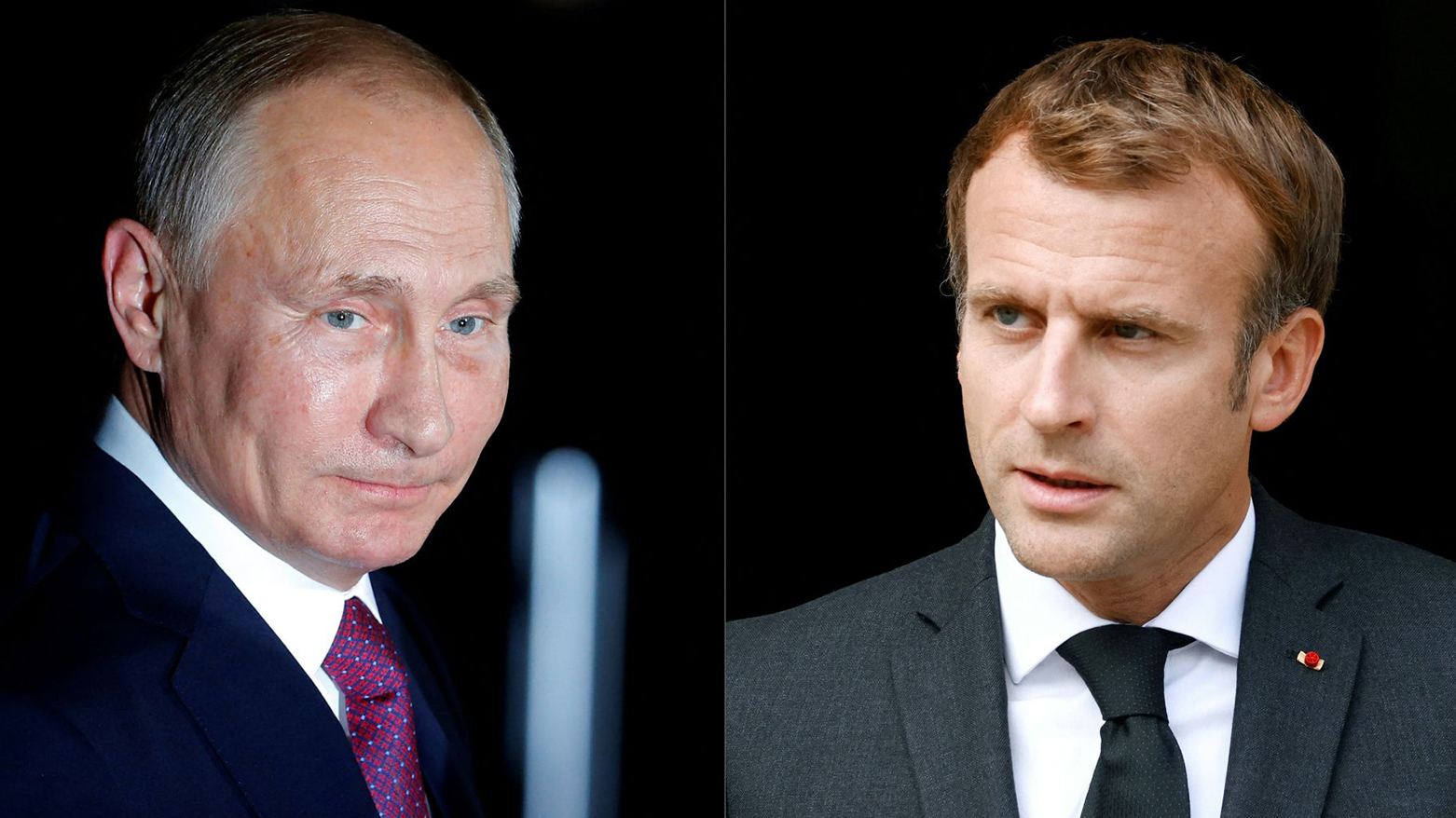
ERBIL (Kurdistan24) — Russian President Vladimir Putin has expressed a willingness to re-engage in direct dialogue with French President Emmanuel Macron regarding the war in Ukraine, the Kremlin announced on Sunday, signaling a potential widening of diplomatic channels as the conflict approaches the end of its fourth year.
The statement, delivered by Kremlin spokesman Dmitry Peskov to the state news agency RIA Novosti, came in direct response to overtures made by Macron earlier in the week. Speaking in Brussels on Friday, the French President suggested that it had become necessary for European leaders to renew communications with Moscow, particularly in light of restored dialogue between the administration of U.S. President Donald Trump and the Russian leadership.
"He [Putin] has expressed readiness to engage in dialogue with Macron," Peskov said in an interview published Sunday. "Therefore, if there is mutual political will, then this can only be assessed positively."
The exchange of public signals between Moscow and Paris marks a notable shift in the diplomatic landscape surrounding the war, occurring against a backdrop of intensified parallel negotiations and deepening disputes over the financing of Ukraine’s defense.
Macron had argued on Friday that Europe must not be sidelined as Washington and Moscow begin to talk.
"I believe that it's in our interest as Europeans and Ukrainians to find the right framework to re-engage this discussion" in the coming weeks, Macron said following a European Union summit.
He warned that relying solely on negotiators who speak to Russia without European input—an allusion to separate talks being conducted by American emissaries—would be "not optimal."
Parallel Diplomacy in Miami
The French President’s urgency appears driven by developments across the Atlantic.
According to reports from Le Figaro and Agence France-Presse (AFP), a series of separate talks are currently underway in Miami involving high-level representatives from Russia, Ukraine, and the United States.
The American delegation in Florida reportedly includes Steve Witkoff, a special envoy for President Trump, and Jared Kushner, the President’s son-in-law.
They are joined in Miami by Kirill Dmitriev, a Russian emissary and economic envoy for Putin, as well as Ukrainian negotiators. The discussions are aimed at exploring frameworks for ending the hostilities, which began with the Russian offensive in February 2022.
The convergence of negotiators in Miami suggests that the incoming U.S. administration is moving aggressively to fulfill campaign pledges to address the conflict, a reality that has seemingly spurred European leaders to ensure their strategic interests are represented in any emerging settlement architecture.
The Dispute Over Frozen Assets
While diplomatic rhetoric softens, economic and financial tensions remain acute.
On Friday, European Union leaders agreed to provide Ukraine with a loan of 90 billion euros ($105 billion) to address looming budget shortfalls. However, the bloc failed to reach a consensus on utilizing frozen Russian assets to fund the aid, a contentious issue that has drawn sharp warnings from the Kremlin.
During his annual year-end press conference held on Friday—distinct from Peskov’s Sunday comments—Putin issued a severe warning regarding the potential seizure of Russian funds held abroad.
Most of the estimated 210 billion euros in frozen assets are located in Europe, primarily managed by Euroclear in Belgium.
Putin characterized any move to use these assets for Kyiv’s benefit as "robbery" and warned that "the consequences for the thieves could be severe."
The issue has created a fissure within the Western alliance.
While many EU states support using the assets, Belgium has voiced opposition, citing fears of retaliation and financial instability.
Furthermore, background reports indicate that the U.S. administration is currently pressuring European capitals to refrain from touching the frozen funds, likely to avoid derailing the sensitive negotiations taking place in Miami.
A U.S. official told AFP that European leaders are privately asking Washington to intervene on the matter while publicly avoiding opposition to maintain institutional credibility.
Battlefield Realities and Russian Confidence
The diplomatic maneuvering coincides with what the Kremlin describes as a decisive shift on the battlefield. During his "Direct Line" press conference and Q&A session on Friday, Putin projected supreme confidence in Russia’s military position.
According to the Russian leader, his forces are "advancing along the entire line of contact," and the "enemy is retreating in all directions." Putin claimed that the "strategic initiative" had shifted entirely to Moscow, asserting that Ukrainian forces had suffered debilitating losses to their strategic reserves.
Putin offered a granular assessment of the front lines in eastern Ukraine, claiming significant progress in the Donetsk People’s Republic. He stated that Russian operations had "liberated" more than half of the city of Konstantinovka and were encircling the settlement of Dimitrov.
He further alleged that Russian troops controlled Kupyansk in the Kharkiv region and had surrounded a group of approximately 3,500 Ukrainian soldiers near the city, describing their chances of escape as "slim to none."
Despite expressing readiness for peace talks, Putin reiterated that any settlement must address the "root causes" of the war.
He reaffirmed the hardline conditions he outlined at the Russian Foreign Ministry in June 2024, which include the full withdrawal of Ukrainian forces from Donbas and Novorossiya, Kyiv’s commitment to non-aligned and non-nuclear status, and the lifting of all Western sanctions.
"We are ready and willing to end this conflict by peaceful means based on the principles that I outlined," Putin said, while noting that Moscow has yet to see a willingness from Kyiv to discuss territorial questions.
In a moment of personal commentary during the press conference, Putin referred to Ukrainian President Volodymyr Zelensky as "a talented actor," a remark he insisted was made "without any sarcasm."
Meanwhile, Zelensky continues to call on Washington to increase pressure on Moscow, even as his government engages in the multilateral talks in Florida and seeks to secure the release of financial aid from Brussels.
As the war enters its fourth winter, the convergence of Putin’s stated willingness to talk, Macron’s push for European relevance, and the active mediation by the Trump administration suggests a pivotal, albeit volatile, phase in the conflict’s trajectory.