Turkey Warns Against Provocations as Syria Escalation Triggers Kurdish Protests and Regional Alarm
Fighting around Kurdish-held areas, prison shelling in Raqqa, and tightened Iraqi borders raise fears of a wider security crisis.
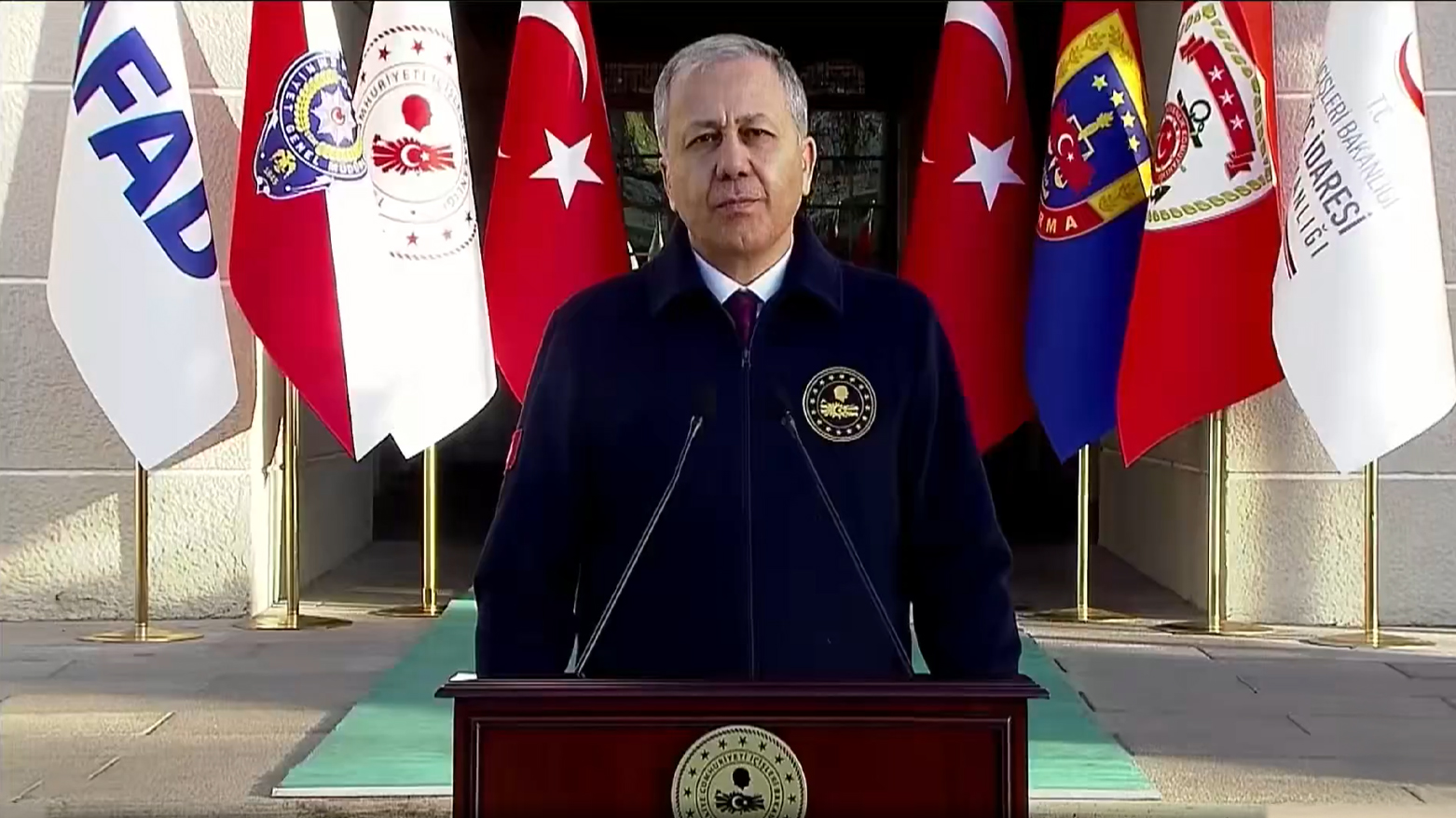
ERBIL (Kurdistan24) — Türkiye warned on Tuesday that it would not tolerate any “provocations” linked to the rapidly deteriorating situation in Syria, as Kurdish groups called for protests against a Syrian government offensive targeting Kurdish fighters and territories.
Turkish Interior Minister Ali Yerlikaya said Ankara was closely monitoring developments across the border, stressing that any actions threatening domestic stability would be met firmly.
“We are meticulously monitoring the developments in Syria and all movements along our border,” Yerlikaya wrote on X, adding that Türkiye would “not tolerate any initiatives or provocations targeting the peace of our country.”
The warning came as tensions rose following a Damascus-led offensive that began nearly two weeks ago, pushing the Kurdish-led Syrian Democratic Forces (SDF) out of parts of northern Aleppo and expanding deeper into areas long held by Kurdish forces.
Murat Karaylan, a senior leader of the Kurdistan Workers’ Party (PKK), said Kurdish militants in Türkiye would “never abandon” Kurds in Syria. Quoted by the Firat news agency, Karaylan described the Syrian offensive as an attempt to undermine peace efforts inside Türkiye.
“Whatever the cost, we will never leave you alone,” he said, accusing international powers of enabling the attacks and calling it a “black mark” on the United States, Britain, Germany, France, and other coalition states.
Türkiye, a close ally of Syria’s new leadership that came to power after the overthrow of Bashar al-Assad in December 2024, is simultaneously pursuing a domestic initiative aimed at reaching a settlement with the PKK, which Ankara and its Western allies designate as a terrorist organization.
Protests have already erupted inside Türkiye. On Monday, at least 500 people rallied in the predominantly Kurdish city of Diyarbakir against the Syrian offensive, with clashes breaking out as police moved to disperse the crowd.
The pro-Kurdish DEM Party, the third-largest force in parliament, called for another demonstration on Tuesday in the border town of Nusaybin.
Meanwhile, the Syrian Arab Army has intensified military operations in northeastern Syria. According to the Syrian Observatory for Human Rights, government forces launched artillery and heavy tank shelling on Aqtan Prison in northern Raqqa, a sensitive facility holding detained Islamic State (ISIS) members, as well as the nearby headquarters of the SDF’s Division 17.
The Observatory said the shelling appeared to be precisely targeted at the prison complex, raising concerns over the security of high-risk detainees. Drones were also observed circling the area, suggesting ongoing aerial surveillance or the possibility of further strikes.
Kurdish security forces were placed on full alert around prisons and security centers across the region, while the SDF reinforced positions to prevent any security vacuum that could be exploited by IS cells. The scale of damage and casualties remains unclear.
Heavy clashes have also been reported between the SDF and armed groups affiliated with Damascus in Jalabiya and in rural areas between Girê Spî (Tal Abyad) and Kobani, underscoring the widening scope of the confrontation.
As violence escalates, neighboring Iraq has moved to fortify its western border. Interior Minister Abdul Amir al-Shammari warned that any armed individuals attempting to cross from Syria would be met with force.
“Any gunman from Syria who attempts to approach Iraq’s borders will be answered with bullets,” he said, stressing that Iraqi forces are on full readiness to defend national sovereignty.
Al-Shammari said Iraq had anticipated such instability years ago and implemented extensive security measures, including the excavation of a defensive trench along 620 kilometers of the border, continuous surveillance via specialized cameras, and air support from warplanes conducting patrols.
The military escalation has coincided with widespread Kurdish protests across the region and in the diaspora. Demonstrations were reported in cities across southern, northern, and western Kurdistan, as well as abroad, calling for an immediate halt to the Syrian government’s offensive.
In Erbil, protesters gathered outside the U.S. Consulate General, waving Kurdistan flags and urging Washington to intervene to prevent what they described as an impending humanitarian catastrophe in Rojava. Similar rallies took place in Zakho, Duhok, Ranya, Khanaqin, Kalar, and in Bochum, Germany, where demonstrators called on European governments to pressure Damascus.
The conflict has also taken on a religious and political dimension. Syria’s Ministry of Endowments instructed mosques to recite the Takbir and pray for a “conquest” by the Syrian Arab Army over the SDF, while Information Minister Hamza Mustafa said the government would not allow the creation of a separate “Jazira Region,” asserting Syria’s territorial unity.
Kurdish leaders have appealed for international intervention. Elham Ahmad, head of foreign relations for the Autonomous Administration, warned that continued global silence would lead to a humanitarian disaster, while the Kurdish National Council in Syria cautioned that the escalation threatens civilians and risks plunging the region into renewed destruction.
Despite a ceasefire announced on Sunday, fighting has continued. The SDF said it repelled attacks near Sarrin, south of Kobani, destroying seven military vehicles and shooting down four drones. Separately, Syria’s Interior Ministry announced the recapture of 81 Islamic State inmates who had escaped from Shaddadi prison in Hasakah, where around 120 detainees fled during earlier attacks.
With shelling ongoing around key detention facilities, borders on high alert, and protests spreading across multiple countries, the region faces a volatile moment in which localized clashes risk escalating into a broader security crisis.