US Signals End of SDF Era, Urges Them to Join Damascus Amid Syrian Army Assault on Kurds
US envoy Tom Barrack says the SDF’s original anti-ISIS mission has ended, as Washington backs Kurdish integration into the Syrian state amid shifting security realities and ongoing instability.
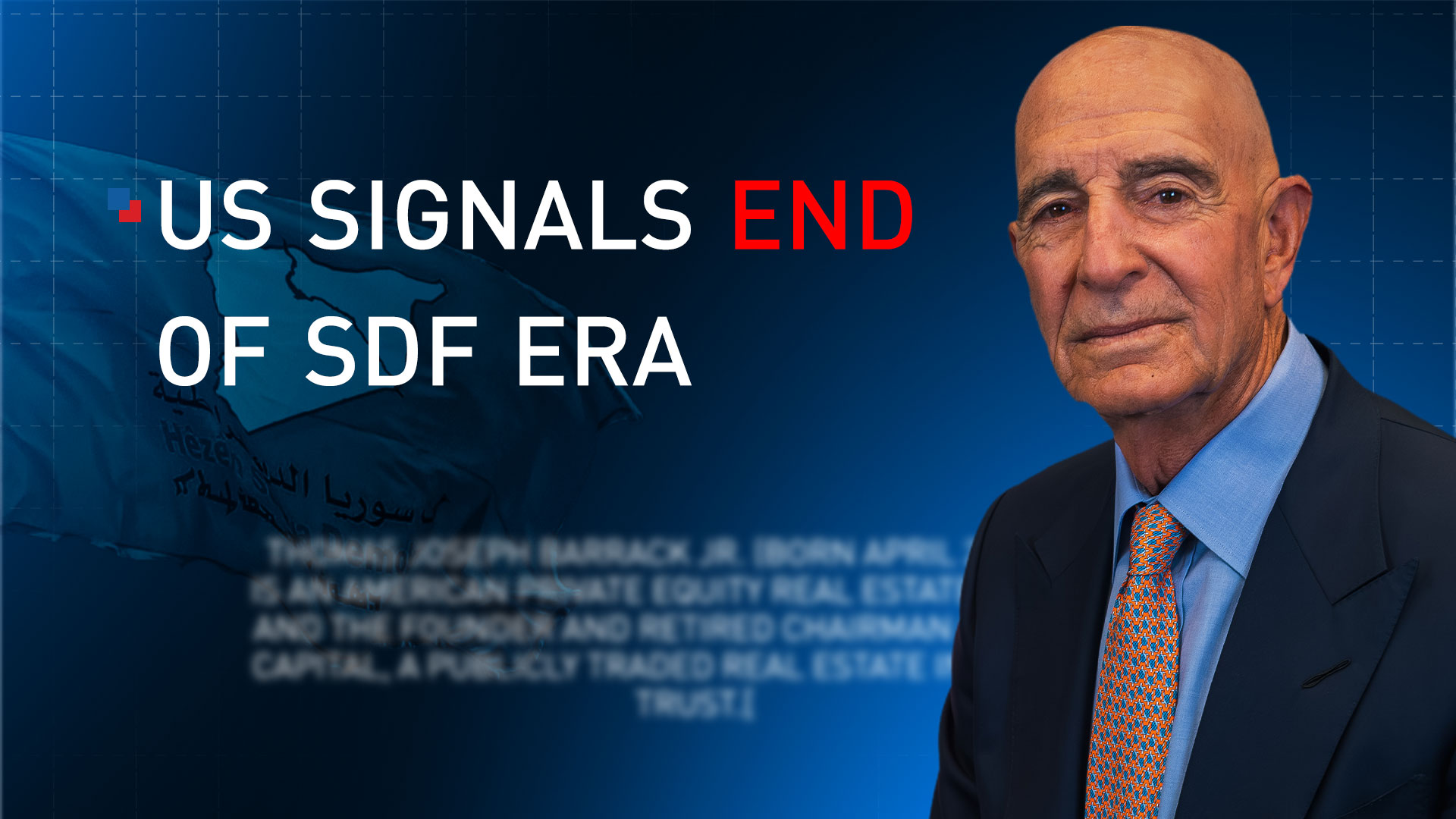
ERBIL (Kurdistan24) - US Ambassador to the Republic of Türkiye and Special Envoy for Syria Tom Barrack said the original role of the Syrian Democratic Forces (SDF) as the primary ground force fighting ISIS has effectively come to an end, as Syria moves into what he described as a fundamentally different political and security phase.
In a statement published on X, Barrack said the greatest opportunity for Kurds in Syria now lies in the post-Assad transition under the new government led by President Ahmed al-Sharaa, describing the moment as a pathway toward full integration into a unified Syrian state with citizenship rights, cultural protections, and political participation.
The greatest opportunity for the Kurds in Syria right now lies in the post-Assad transition under the new government led by President Ahmed al-Sharaa. This moment offers a pathway to full integration into a unified Syrian state with citizenship rights, cultural protections, and…
— Ambassador Tom Barrack (@USAMBTurkiye) January 20, 2026
Barrack said these rights had long been denied under Bashar al-Assad’s rule, when many Kurds faced statelessness, language restrictions, and systemic discrimination.
He noted that the US military presence in northeastern Syria had historically been justified primarily through the fight against ISIS. In that context, Barrack said, the Kurdish-led SDF proved to be the most effective ground partner in defeating ISIS’s territorial caliphate by 2019, detaining thousands of ISIS fighters and their family members in prisons and camps, including al-Hol and al-Shaddadi.
At the time, Barrack said, there was no functioning central Syrian state to partner with, describing the Assad regime as weakened, contested, and not a viable counterterrorism partner because of its alliances with Iran and Russia.
“Today, the situation has fundamentally changed,” Barrack said, adding that Syria now has an acknowledged central government that joined the Global Coalition to Defeat ISIS as its ninetieth member in late 2025. He said this signaled a westward pivot and cooperation with the United States on counterterrorism.
According to Barrack, this development shifts the rationale for the US-SDF partnership, as the original purpose of the SDF as the primary anti-ISIS force on the ground has largely expired. He said Damascus is now willing and positioned to take over security responsibilities, including control of ISIS detention facilities and camps.
Barrack said recent developments show the United States is actively facilitating this transition rather than prolonging a separate SDF role. He said Washington has engaged extensively with the Syrian government and SDF leadership to secure an integration agreement signed on Jan. 18, and to establish a clear pathway for timely and peaceful implementation.
He said the agreement integrates SDF fighters into the national military as individuals, hands over key infrastructure including oil fields, dams, and border crossings, and transfers control of ISIS prisons and camps to Damascus. Barrack described the individual integration of fighters as among the most contentious issues.
“The US has no interest in long-term military presence,” Barrack said, adding that Washington prioritizes defeating ISIS remnants, supporting reconciliation, and advancing national unity without endorsing separatism or federalism.
He said this transition creates what he called a unique window for Kurds, arguing that integration into the new Syrian state offers full citizenship rights, including for those previously stateless, recognition as an integral part of Syria, constitutional protections for Kurdish language and culture, such as teaching in Kurdish and celebrating Nawruz as a national holiday, and participation in governance.
Barrack said these prospects go beyond the semi-autonomy the SDF held during the chaos of the civil war.
He acknowledged that risks remain, including fragile ceasefires, occasional clashes, concerns over hardliners, and the desire of some actors to revisit past grievances, but said the United States is pushing for safeguards on Kurdish rights and continued counter-ISIS cooperation.
“The alternative—prolonged separation—could invite instability or ISIS resurgence,” Barrack said, adding that US-backed integration represents the strongest chance yet for Kurds to secure lasting rights and security within a recognized Syrian nation-state.
He said US efforts in Syria are now focused on ensuring the security of prison facilities holding ISIS detainees, currently guarded by the SDF, and facilitating talks between the SDF and the Syrian government to allow for peaceful integration and political inclusion of Syria’s Kurdish population into full Syrian citizenship.
Barrack’s remarks come amid escalating security tensions in northern and eastern Syria. SDF General Commander Mazloum Abdi has said his forces withdrew to Kurdish-majority areas and stressed that protecting those areas constitutes a “red line” the SDF will not hesitate to defend.
In a statement to the Kurdish Hawar News Agency, Abdi said the SDF salutes “the resistance of civilians and fighters in all areas subjected to brutal attacks and systematic killing against Kurds,” as he warned of a sharp deterioration in security conditions affecting cities, camps, and detention facilities holding ISIS members and their families.
Abdi said attacks have intensified against detention sites in Shaddadi and al-Hol camp, adding that al-Hol has faced violent assaults and attempts to storm and seize control of it by force. He said guards at the camp were confronted with military convoys, armored vehicles, and tanks, forcing them to withdraw.
He also said the Syrian government continues intense attacks on the city of Hasakah, its countryside, and the city of Kobani, and accused Damascus of failing to respond to ceasefire initiatives launched over the previous two weeks.
“We withdrew to areas with a Kurdish majority, and protecting them is a red line that we will not hesitate to defend,” Abdi said, while calling on the international coalition to assume responsibility for protecting ISIS detention facilities and urging the Syrian government to halt attacks and return to dialogue.
Security concerns have been compounded by US estimates that around 200 ISIS detainees escaped from Shaddadi prison following attacks linked to the Syrian Arab Army. The prison, previously under SDF control, is one of two main facilities holding the largest number of ISIS militants, alongside Gweiran prison. Together, the two facilities held nearly 10,000 ISIS fighters, with Shaddadi alone housing between 3,000 and 5,000 detainees, including Iraqi and Syrian members and nearly 2,000 foreign nationals from fifty-eight countries.
The deteriorating situation has drawn warnings from international figures, including Yazidi survivor of ISIS captivity and Nobel Peace Prize laureate Nadia Murad. In a statement published on X, Murad said the Kurds who fought on the front lines against ISIS are now being abandoned by the international community.
“The US-led coalition relied on Kurdish forces in Rojava to fight and defeat ISIS,” she wrote. “Now, at a critical moment, those who stood on the front lines against evil are being abandoned.”
Kurdish-led forces have also announced a withdrawal from al-Hol camp, citing mounting security threats and what they described as continued international indifference toward the ISIS issue. In an official statement, the SDF Media Center said its forces redeployed away from the camp to focus on protecting cities facing increasing dangers.
As Washington signals a shift from partnership to integration and Damascus moves to reclaim security responsibilities, the future of the SDF and Syria’s Kurds now hinges on whether promises of citizenship, protection, and inclusion can hold amid persistent instability and unresolved threats.