U.S. Urges New Iraqi Government to Disarm Armed Groups, Embrace Stability
Speaking exclusively to Kurdistan24, Michael Rigas, U.S. Deputy Assistant Secretary of State, stressed that curbing the power of armed groups remains a central U.S. objective in its engagement with Iraq.
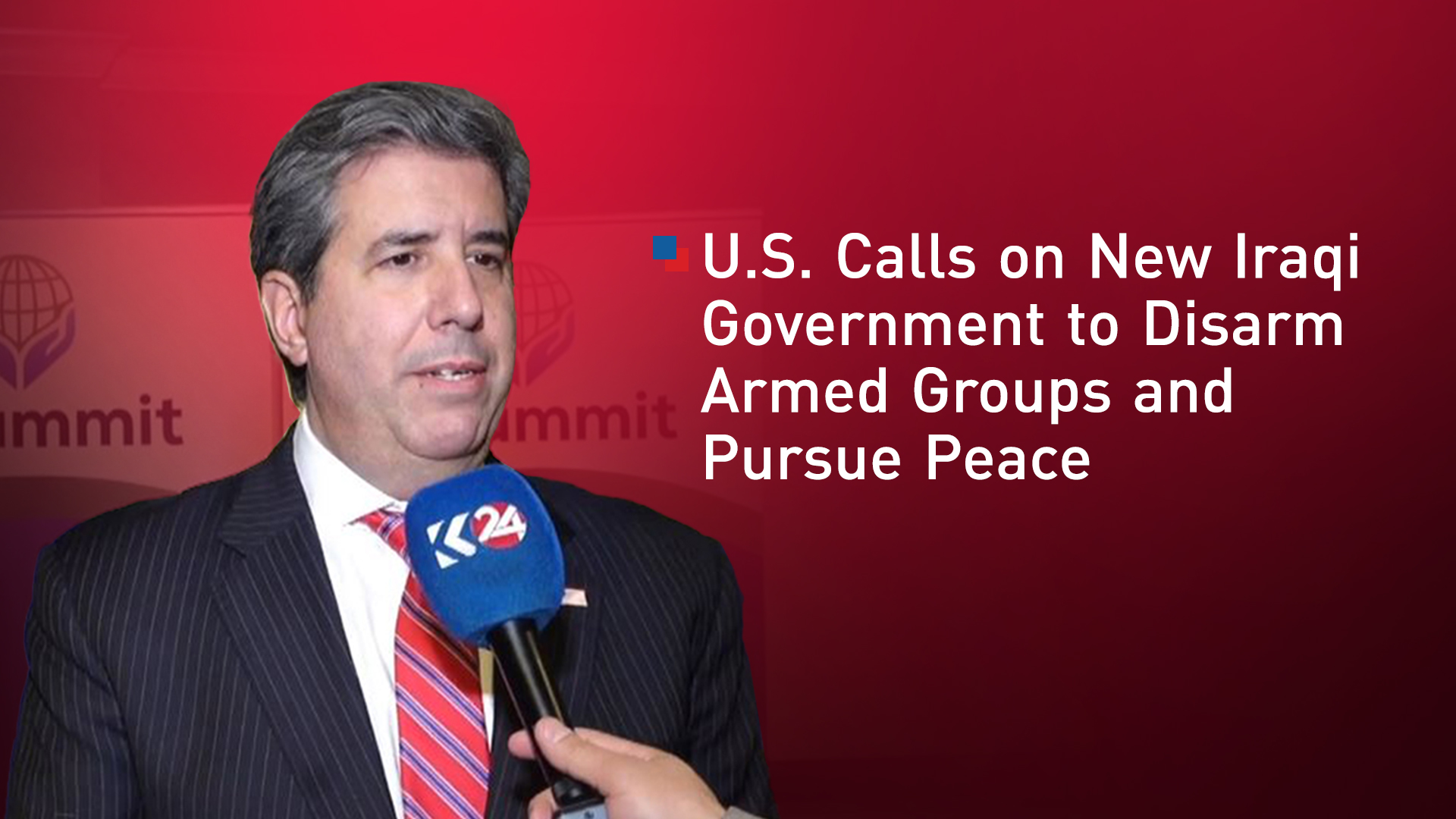
ERBIL (Kurdistan24) — The United States has called on Iraq’s incoming government to prioritize peace, state authority, and the disarmament of armed groups, as Washington intensifies diplomatic engagement amid ongoing political deadlock in Baghdad.
Michael Rigas, U.S. Deputy Assistant Secretary of State for Management and Resources, said Washington wants a new Iraqi government that is “peace-oriented” and capable of disarming armed factions, while working in the interest of all Iraqis.
Speaking exclusively to Kurdistan24, Rigas stressed that curbing the power of armed groups remains a central U.S. objective in its engagement with Iraq.
Rigas said U.S. officials have encouraged Iraqi leaders to move quickly to form a government and to address the issue of armed factions in a way that allows them to be integrated peacefully into the political process, rather than operating outside state control.
He emphasized that such steps are essential for long-term stability, governance, and economic recovery.
His remarks come as Iraq continues to grapple with the legacy of powerful militias that emerged during the fight against the Islamic State (ISIS) and later entrenched themselves politically and militarily.
While many of these groups are formally affiliated with the Popular Mobilization Forces (PMF), critics argue that some maintain parallel chains of command and act independently of the state, undermining sovereignty and the rule of law.
Rigas also highlighted recent U.S. diplomatic activity in Iraq and the Kurdistan Region, noting that he had personally visited both. He said the United States recently opened a new consulate facility in Erbil and held meetings with a range of political and government officials.
During these talks, U.S. officials urged Iraqi leaders to accelerate government formation and pursue security sector reforms, particularly the regulation of armed groups.
Addressing speculation about potential changes in the U.S. diplomatic file on Iraq, including reports about Mark Savaya being replaced by Tom Barrack, Rigas said no official announcement has been made. However, he praised Barrack’s performance in Syria, saying he has served U.S. President Donald Trump’s agenda effectively.
Rigas pointed to Barrack’s roles as U.S. ambassador to Türkiye and as Washington’s special envoy to Syria, describing his work as “exceptional.”
On questions about alleged U.S. vetoes of certain political figures in Iraq, Rigas said President Trump has recently made his position clear on government formation and Washington’s expectations.
He reiterated that while the United States recognizes Iraq’s political customs for power-sharing among its components, it is urging all sides to form a resilient, peace-oriented government capable of engaging diplomatically with the U.S. and the wider international community.
In concluding remarks, Rigas again declined to comment on any confirmed changes regarding Savaya or Barrack in the Iraq portfolio, but reaffirmed U.S. confidence in Barrack’s record and loyalty to President Trump’s foreign policy objectives.
The statements reflect growing U.S. concern over Iraq’s protracted political uncertainty and the continued influence of armed groups, as Washington presses for a government that can assert state authority, stabilize the country, and maintain constructive relations with regional and global partners.