Syrian and Turkish Presidents Pledge Enhanced Coordination Following Damascus-SDF Integration Deal
Syrian and Turkish presidents pledged high-level coordination Monday following a Syria-SDF integration deal. The agreement involves SDF merging into state forces, PKK removal, and Kurdish rights recognition.
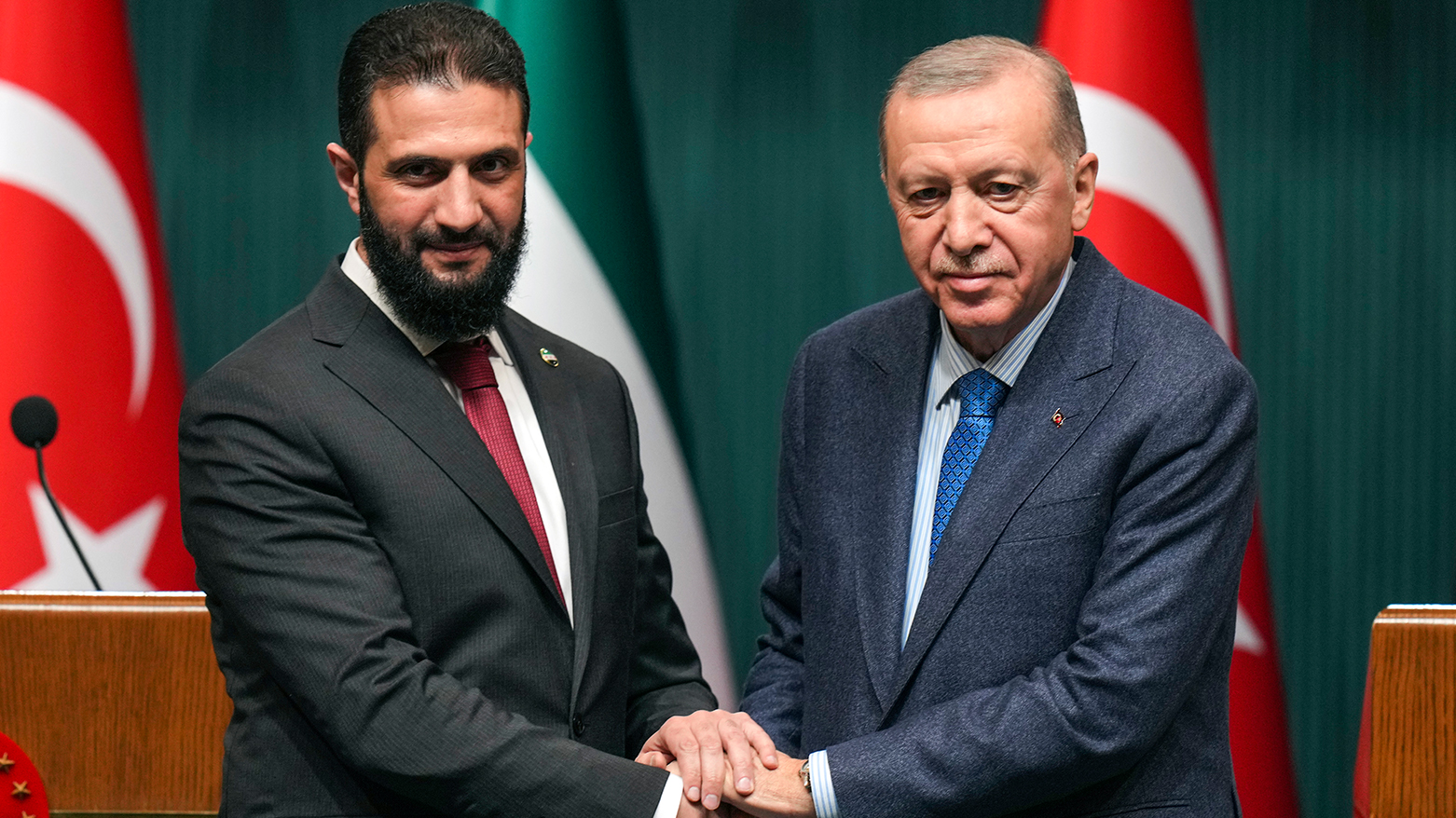
ERBIL (Kurdistan24) - Syrian President Ahmed al-Sharaa and Turkish President Recep Tayyip Erdogan emphasized the necessity of imposing state sovereignty over all Syrian territory during a telephone conversation on Monday, signaling a potential realignment of regional relations following the announcement of a comprehensive integration agreement between Damascus and the Syrian Democratic Forces (SDF).
The high-level discussion took place early Monday morning, according to the official Syrian news agency, SANA. During the call, both leaders discussed the rapidly evolving security landscape and its repercussions for the broader region.
The Syrian President al-Sharaa reportedly underscored the importance of Syria’s territorial integrity, framing the re-establishment of central government authority as the essential basis for long-term stability.
According to the official statement, both presidents affirmed the strength of relations between Damascus and Ankara, pledging to maintain coordination at the highest levels.
The leaders agreed to continue dialogue and consultation on files of mutual interest, a diplomatic signaling that suggests Türkiye may be receptive to the new security architecture emerging in northeast Syria, provided it addresses Ankara’s long-standing security concerns regarding Kurdish militant groups.
The conversation between the two heads of state occurred less than 24 hours after President al-Sharaa announced the finalization of a 14-point agreement with the SDF.
That deal, made public on Sunday, aims to dissolve the autonomous military and administrative structures that have governed northeast Syria for more than a decade, integrating them into the central state apparatus in exchange for the recognition of Kurdish cultural rights.
The agreement, which the Syrian Ministry of Defense has already begun implementing through a nationwide ceasefire order, outlines a fundamental restructuring of the country's north and east. Under the terms of the accord, the SDF has committed to withdrawing its military formations to the east of the Euphrates River as a preliminary step for redeployment.
Consequently, the Syrian government is set to assume full administrative and military control over the governorates of Deir ez-Zor and Raqqa, as well as all border crossings and strategic energy infrastructure, including oil and gas fields.
Crucially for Ankara, the agreement contains specific provisions regarding non-Syrian combatants.
The twelfth clause of the deal explicitly commits the SDF to the removal of all non-Syrian Kurdistan Workers’ Party (PKK) leaders and members from the territory of the Syrian Arab Republic.
This provision appears designed to satisfy Turkish security demands and facilitate the "strength of relations" emphasized by Erdogan and al-Sharaa during their Monday call.
The diplomatic breakthrough has drawn support from major international players, including the United States. Tom Barrack, the U.S. Special Envoy for Syria, officially endorsed the integration plan on Sunday.
In a statement, Barrack commended both the Syrian government and the SDF for their constructive efforts, describing the agreement as a bridge toward a unified Syria. He noted that the deal allows for the "seamless integration" of the SDF—a partner in the fight against ISIS—into the Syrian state, which remains a member of the Global Coalition.
The diplomatic framework enabling this agreement relied heavily on regional mediation, with a prominent role played by the leadership of the Kurdistan Region.
Speaking at a news conference on Sunday, President al-Sharaa publicly expressed gratitude to President Masoud Barzani, highlighting him as "one of the key figures who played a significant role" in facilitating the dialogue.
Following the announcement of the deal, President Barzani and President al-Sharaa held a telephone conversation to discuss the details of the agreement.
According to a statement from Barzani Headquarters, the two leaders emphasized that Kurdish rights and their protection within Syria must be respected.
President Barzani viewed the Syrian president's issuance of Presidential Decree No. 13 of 2026—which recognizes Kurdish cultural and linguistic rights and addresses the status of stateless persons—as a positive step that establishes a strong foundation for future relations.
On the ground, the implementation of the agreement is being framed by SDF leadership as a necessary measure to protect the population from further conflict.
Mazloum Abdi, the General Commander of the SDF, stated in a televised address that his forces had been subjected to a planned and violent attack beginning January 6. Describing the decision to redeploy forces from Deir ez-Zor and Raqqa to Hasakah, General Abdi said the move was intended to protect civilians and preserve the gains achieved during the conflict.
General Abdi confirmed that the SDF would not incorporate remnants of the former regime into its ranks but would integrate into the Syrian Ministries of Defense and Interior on an individual basis. He emphasized that the struggle for the region’s achievements would continue through political and defensive means within the new state framework.
A scheduled meeting between General Abdi and President al-Sharaa in Damascus was postponed to Tuesday due to adverse weather conditions, though the ceasefire remains in effect.
The convergence of the U.S.-backed integration plan, the mediation by the Kurdistan Region, and the apparent acquiescence of Türkiye marks a decisive shift in the Syrian conflict.
By securing Ankara's coordination, Damascus aims to consolidate control over its borders while closing the chapter on the autonomous administration, replacing it with a centralized system that grants specific cultural concessions to the Kurdish population.
President al-Sharaa also extended thanks to U.S. President Donald Trump, French President Emmanuel Macron, and the leaders of Jordan, Saudi Arabia, and Qatar, indicating a broad consensus among external powers to support this transition from division toward unity.
As the Syrian Ministry of Defense opens corridors for the return of displaced residents, the focus now shifts to the practical implementation of the integration and the verification of the security pledges made to neighboring states.